Who we are
About us
Fifteen years building software in Australia. Two of them spent learning skip bins properly.
Fifteen years building software in Australia. Two of them spent learning skip bins properly.
We have been providing web and software services in Australia for more than fifteen years. Skip Pilot came out of the last two of those, spent inside the skip bin industry, working alongside operators instead of guessing at what they needed.
That is the part most software gets wrong. Plenty of products can store a booking. Very few are built by people who have sat with an operator at 6am while they work out which truck goes where, or watched a job get missed because the message telling the driver about it was three screens back in a group chat.
What we kept seeing was the same story, over and over. Runs planned in someone's head, on a whiteboard that gets wiped, or in a spreadsheet that one person maintains and nobody else can follow. Jobs sent to drivers over WhatsApp, where a changed address or a cancelled pickup disappears up the thread within an hour. Deliveries missed. Pickups forgotten. Customers ringing to ask where their bin is, and nobody able to answer without scrolling back through weeks of messages.
Then the quieter problem underneath it: bins going missing. Not stolen, just lost track of. Sitting on a site for three weeks earning nothing because no reminder existed to bring them back. Operators working flat out and still not knowing which parts of the business actually made money.
None of that is a people problem. It is what happens when a business outgrows the tools it started with, and there is no easy way to manage the whole thing in one place.
It is not only skip bins, either. We have helped businesses in other hire and service industries that were running exactly the same way: a spreadsheet holding the schedule, a group chat holding the instructions, and the owner holding the rest in their head. The equipment changes. The problem does not.

Not a bigger system with more buttons. A simpler one that a driver can use with one hand and an owner can read in a glance.
Whether you are an owner driver doing your own runs or you are dispatching a fleet of twenty-plus trucks, it is the same system and the same short learning curve. Nobody needs a training week. Most operators are running live jobs the same day.
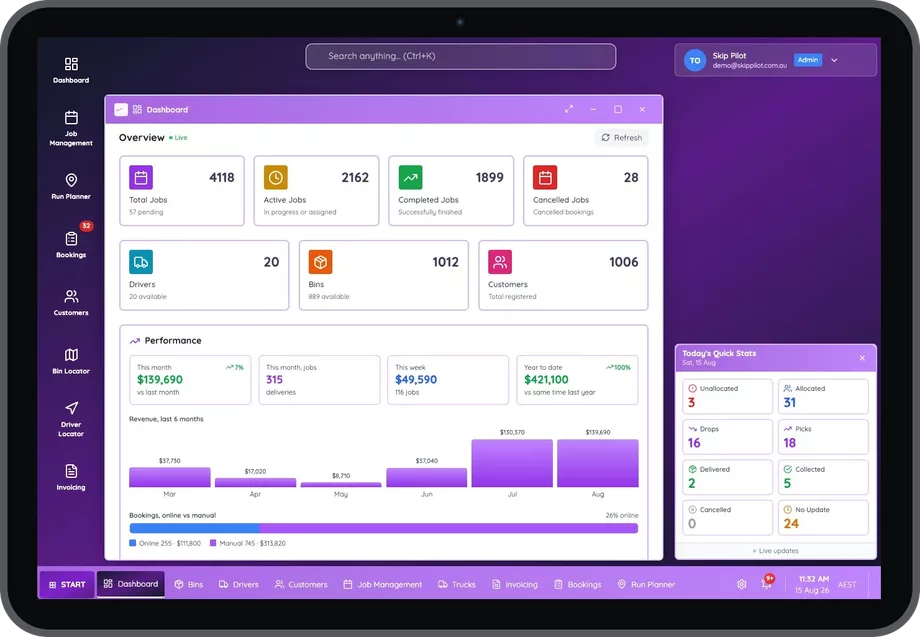
Plan your routes, manage bookings, locate every bin, see tomorrow's load before it arrives, and see where your drivers are right now. The run goes to the driver's phone instead of a group chat, so the job they see is always the current one.
Desktop in the office, phone in the truck, tablet on site. Admin and drivers each get a view built for the screen they are actually holding, so the business does not stop because you are not at a computer.
Tell us how you operate now, WhatsApp groups and all, and we will show you what it looks like in Skip Pilot. No pressure and no jargon.